About the Nicola Watershed Governance Partnership (NWGP)
- Home
- »
- About the nwgp
About the Governance Partnership
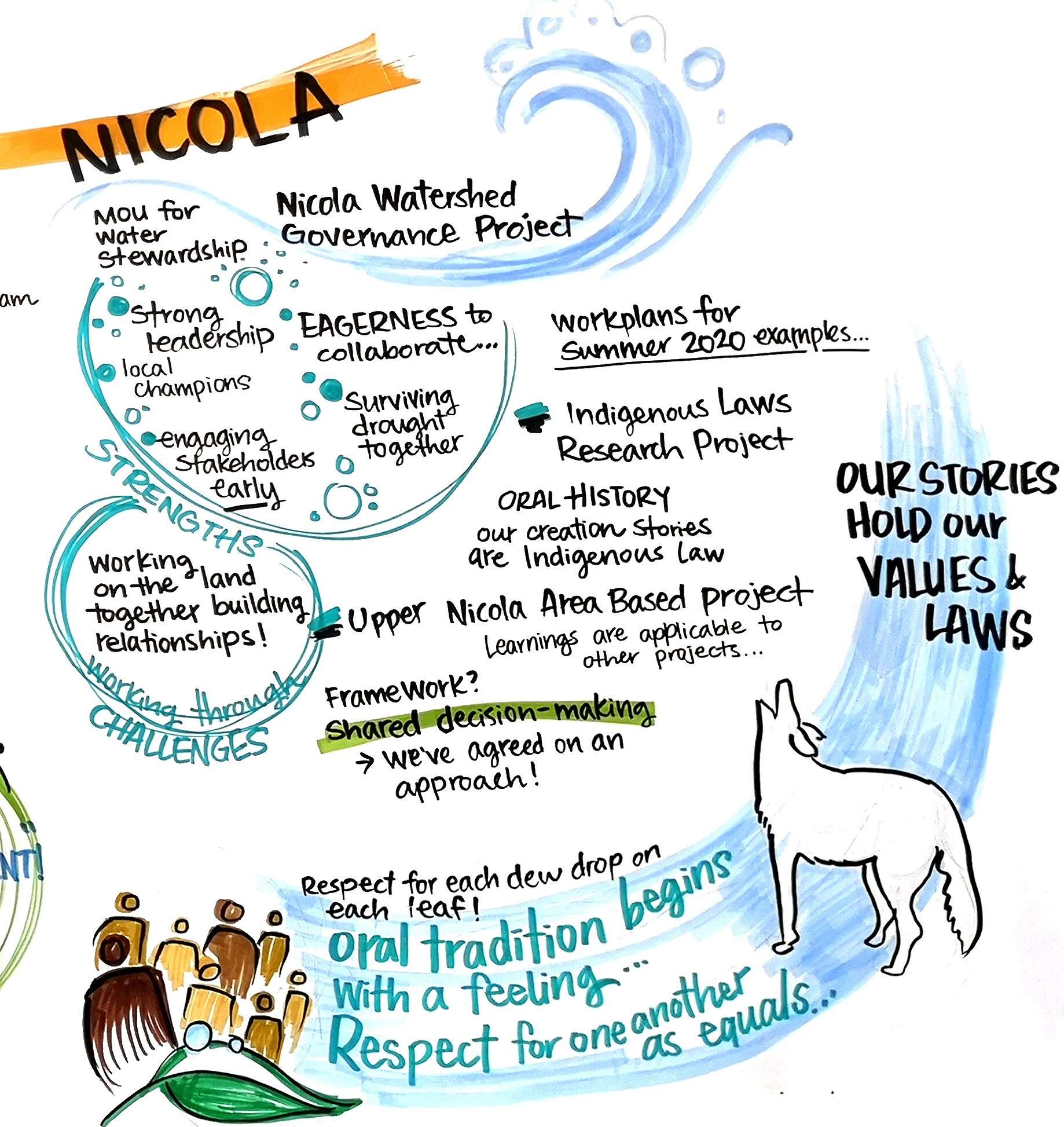
The Nicola Watershed Governance Partnership involves the Province of BC and the Nicola 5 First Nations Governments working together under a formal agreement to improve the health of the water and advance reconciliation. The Province of BC and the Nicola 5 First Nations are working in partnership, and through engagement with local communities and stakeholders, to sustainably govern water.
The Five Nicola First Nations Governments are (collectively known as the Nicola 5):
- Coldwater Indian Band (Nłeʔkepmx Nation)
- Lower Nicola Indian Band (Nłeʔkepmx Nation)
- Nooaitch Indian Band (Nłeʔkepmx Nation)
- Shackan Indian Band (Nłeʔkepmx Nation)
- Upper Nicola Band (syilx Nation).
Water sustains and connects all who live in the Nicola watershed. We all need water to drink and this water comes from our rivers, lakes and aquifers. The waterways are places where people come to relax and play, where we swim and paddle and where we can learn firsthand about the cycles of nature. The waterways are home to species that sustain us, physically and culturally and whom we have a responsibility to sustain in return. Healthy waterways and aquifers are essential for Indigenous communities to exercise their water-related rights, responsibilities, and laws. Water is also a vital resource for agriculture, ranching, mining, forestry and tourism which provide livelihoods to many in the watershed.
Like our bodies, bodies of water can become unhealthy if they are not treated with care and respect. Today the health of many local waterways is under threat. Taking out too much water, removing streamside vegetation or allowing pollutants and rubbish to enter the water causes harm to the waterways. A changing climate adds to these pressures. Ultimately the health of the waterways affects the health and wellbeing of people who live in the watershed, as well as fish, plants and animals who rely on water. When the waters are in an unhealthy state, it becomes difficult for communities to feel their future is secure.
Our children and grandchildren will need healthy waterways just as we do. With so much at stake in the watershed, it is a good time to find new ways to work together to solve these problems. This is what is happening through the Nicola Watershed Governance Partnership (NWGP).
Origin Story of the NWGP Logo
The Nicola Watershed Governance Partnership (NWGP) is grounded in shared decision-making. This mandate is supported by the three pillars of a strong government-to-government partnership with equal footing, good governance that is inclusive of all in the watershed, and sustainable water management using both Indigenous and settler ways of knowing and being.
It was important that these elements be represented in the NWGP logo.
The NWGP logo was collaboratively developed by the NWGP Core Council and staff with support from both ESSA Technologies and Indigenous Marketing.
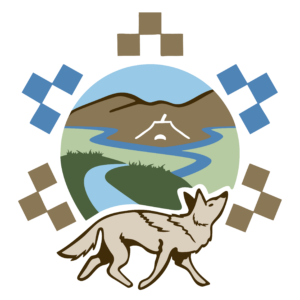

From the outside in, the first element you see is the Interior Salish basketry motif designed by Lower Nicola Indian Band award-winning Artist, and Core Council delegate, Xéysmkn, Robin Humphrey.
Xéysmkn, Robin notes that traditional Interior Salish basketry motifs are not often seen in graphics. This is despite the widespread recognition for Nłeʔkepmx women’s basket-making and a long history of the baskets’ trade, and later, contributions to the economy. The sale of baskets to settlers in the late 1800s and early 1900s became integral to raising funds for campaigns and delegations to defend Indigenous Rights in BC, Ottawa, and London as colonialism continued.
The braiding of the two colours in the basketry also represents the way that the work of the NWGP draws on the two knowledge systems: Indigenous Knowledge and laws alongside Western science and Crown laws.
Prominently featured at the base of the logo is Coyote.
“We are all Coyote”: Coyote represents all people in the watershed, settler and Indigenous, and our shared responsibility to maintain balance among all tmixw and tmxwulaxw, wildlife and lands, for our shared survival. This reflects the inclusive and collaborative nature of the NWGP where everyone in the watershed can engage.
Coyote is a central figure in Nłeʔkepmx and syilx oral histories. Coyote would travel across the entire Nłeʔkepmx and syilx territories from post to post, teaching people how to be and ensuring the people and nature are cared for.
Coyote links to another element of the logo: the Interior Salish pithouse, known as sʔístkn in Nłeʔkepmxcin and qʷc̓iʔ in nsyilxcən.
This pithouse, also designed by Xéysmkn, Robin, is placed in the middle of the valley to represent Coyote House, one of Coyote’s posts located in what is now known as Merritt. In this way, Coyote House represents the people on the landscape.
Coyote House, made of mostly gravel material, was destroyed without consultation with the Nicola Five First Nations to make way for new roads leading to the City of Merritt. However, this site’s history has recently opened a new chapter with the success of the Water Authorizations Pilot, an initiative of the Nk’eʔxép (Drought) Management Committee. The Water Authorization Pilot, which ceremonially took place at a section next to the river, near the landmark known as Coyote House, forged a path to using both Crown and Indigenous laws in decision-making regarding water use allocations.
The centre of the logo also features a landscape etched with flowing water, representing the Nicola Watershed. The two rivers represent the Coldwater and Nicola Rivers whose confluence is in Merritt.
Where these waters meet embodies the government-to-government partnership of the Nicola Five First Nations and the Province of BC, who join on equal footing like the equal flows of the rivers in the design.
How We’re Funded
The NWGP is committed to the wise, prudent, and transparent use of funds. The parties are accountable to each other and the public about how funds are acquired, allocated and spent.
What are the current sources of funding for the NWGP?
Collaborative Stewardship Framework
The NWGP is a Collaborative Stewardship Framework (CSF) partnership. The Collaborative Stewardship Framework (CSF) was initiated in 2018 as a pilot to test how information reflecting Western and Indigenous knowledge can enhance natural resource decision-making through a collaborative land stewardship approach between the Province and more than 30 First Nations in five CSF forums.
The partnerships show how Indigenous knowledge can be incorporated into and improve natural resource management. CSF is designed and implemented collaboratively.
Other CSF partnerships include:
- S’ólh Téméxw Stewardship Alliance
- 3 Nations Collaborative Stewardship Forum
- Ktunaxa Forum
- The Southern Dekelh Nation Alliance Forum
Initially funded by the Province and the BC Freshwater Legacy, the pilot was selected to be a part of the CSF. This additional support and funding allowed for the forum members of the G2G Nicola Pilot to enhance their scope of work and develop longer-term initiatives informed by engagement with local communities and stakeholders.
For more information on CSF partnerships across the province of BC, please see the Collaborative Stewardship Framework.