About the Nicola Watershed Governance Partnership (NWGP)
- Home
- »
- About the NWGP
- »
- About the Partners
Nicola Nations: Stewards of the Land and Waters Since Time Immemorial
First Nation communities from the Nłeʔkepmx Nation and syilx Nation have a long history of close collaboration, self-determination, and stewardship in the Nicola Valley. The Nicola 5 First Nations refers to a collective comprised of the Coldwater, Lower Nicola, Nooaitch and Shackan Bands of the Nłeʔkepmx Nation; and, the Upper Nicola Band of the syilx Okanagan Nation. The Nłeʔkepmx and syilx communities have distinct, diverse, rich, complex, and sacred connections to the Nicola Valley. Each community has distinct governance decisions and stewardship obligations. Together, the Nicola 5 First Nations comprise over 3,000 members; all are part of proud, strong, thriving Indigenous Nations of the BC interior who are applying their laws and customs, passed down through the generations.
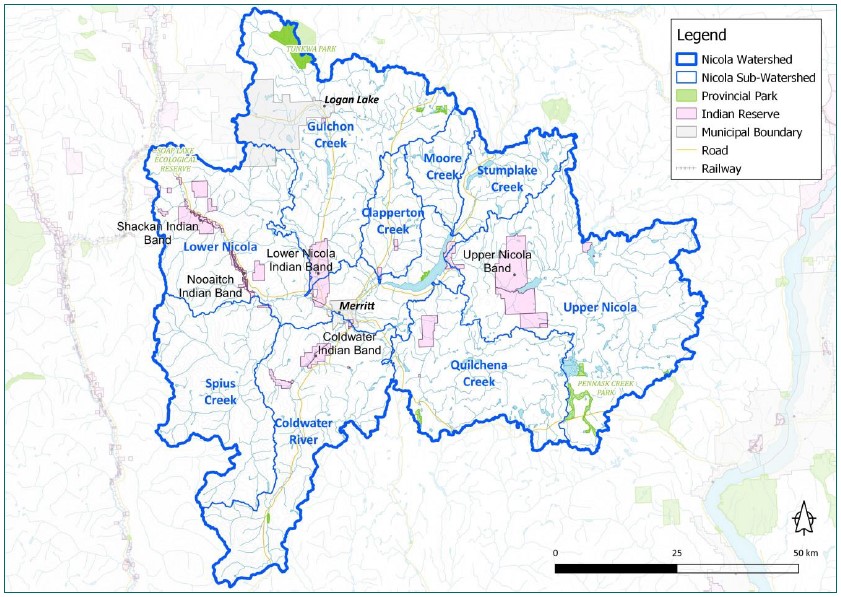
IMAGE: A map of the Nicola Valley showing sub-basins (blue), First Nation communities, parks, and municipalities.
For millennia, the rivers, valleys, and mountain passes of the watershed provided travel routes for communities to access the resources they needed year-round to live a good and abundant life. Long before settlers arrived in the Nicola Valley, Indigenous peoples fished salmon in the rivers and streams, hunted game in the forests, mountains, and grasslands, and gathered plants and medicines throughout the territory.
When the early settlers arrived in the Nicola Valley, they found village sites at the foot of lakes, fish weirs along principle streams, and trails between water features connecting cultural landscapes and Indigenous people with a strong understanding of the interconnectedness of land, water and other resources.
The expansion of settlement resulted in land dispossession. The first reserves in the Nicola Valley were established in 1868, months after early settlers recorded the first land pre-emptions and water records. The first reserves did not include water interests, but later allocations were made by the Indian Reserve Commission in 1878 and local Indian Agent. Whether or not communities had recognized water licences, the stewardship responsibility to care for water and water resources were priorities for the Nicola bands. As settlement increased, diverse and competing interests developed in the Nicola Valley for the limited water resources. Friendships and inter-marriage helped forge relationships that spanned generations between some of the settlers and First Nations people. This is evident in each of the Nicola 5 communities that have members that are descendants of some of Merritt’s earliest settlers.
In the early 1900s, along with other bands from the Nłeʔkepmx, Secwe̓pemc, and syilx Nations, the Nicola 5 First Nations joined forces as the Delegation of Interior Allied Indian Chiefs and began the long campaign toward First Nations title and rights. One of the issues of concern for the Allied Tribes of that time was the issue of water. For the last 100 years, working together as a collective, and individually as communities, the Nicola 5 have been strong advocates for the Nicola watershed.
Over the years, the Chiefs in the Nicola Valley have earned great respect as the Nicola 5, and are known to be strong examples of creating action for their people through collaborative leadership. They continue to expand the interests of the Nicola 5 year after year, sharing many core principles established for them by their ancestors. An example of one such principle is the teaching kəntwaxʷ (Nłeʔkepmx language, Nłeʔkepmxcin) and knxtwixʷəxʷ (syilx language, nsyilxcen). This term roughly translates to the notion of helping each other, although the English translation does not capture the depth and nuanced meanings embedded in the term. These terms speak to the fundamental ethics and governance principles of mutual care, support, responsibility, and respect that Nłeʔkepmx and syilx peoples embrace and embody. Nłeʔkepmxcin and nsyilxcen are rich, descriptive, multi-faceted languages. These terms and their interpretations continue to be explored and validated with language speakers.
Nłeʔkepmxcin and nsyilxcen languages have alphabets with letters that are not included on the standard English keyboard. To type these letters, install the Nłeʔkepmxcin and nsyilxcen keyboards:
Nłeʔkepmxcin keyboard can be installed here.
nsyilxcen keyboard can be installed here (link coming soon).
The Province of British Columbia
The two provincial ministries participating in the Nicola Watershed Governance Partnership are the Ministry of Water, Land and Resource Stewardship (WLRS) and the Ministry of Indigenous Relations and Reconciliation (MIRR). The Ministry of Forests (FOR) and Ministry of Agriculture and Food (AGR) are also connected to the work of the NWGP. Each ministry has specific roles and responsibilities related to water management and reconciliation.